27 February 2012

Project Funda : Newspapers


वर्तमानपत्रे : वाचनसंस्कृती रुजविणारे प्रभावी साधन

प्रत्येक वर्तमानपत्राचं शीर्षक वेगवेगळ्या प्रकारे लिहिलं जातं. या शीर्षकामध्ये अक्षरं लिहिण्याची शैली, अक्षरांचा आकार, रंगसंगती वेगवेगळी असते. त्याचप्रमाणे वर्तमानपत्राच्या शीर्षकाखाली दिनांक, वार, आवृत्ती प्रकाशित झाल्याचे ठिकाण, किंमत, पृष्ठसंख्या इत्यादी माहिती दिलेली असते. प्राथमिक स्तरावर शिकणाऱ्या विद्यार्थ्यांना त्यांच्या गावात उपलब्ध होणाऱ्या वर्तमानपत्रांच्या शीर्षकांची कात्रणे चिकटवहीत चिकटवून शीर्षकाखाली छापलेल्या माहितीचे निरीक्षण व नोंद करण्यास सांगता येईल.
वर्तमानपत्रासाठी बातमी कशी मिळवली जाते, त्या बातमीचं प्रभावी सादरीकरण करण्यासाठी छायाचित्रे कशी घेतली जातात, या बातमीवर वार्ताहरापासून ते संपादकांपर्यंत कोण-कोण आणि कसे लेखन संस्कार करतात, बातमी छापण्यामध्ये पेज डिझायनरची भूमिका काय असते, वर्तमानपत्राची छपाई कशी केली जाते, गावोगावी ही सगळी वर्तमानपत्रं योग्य वेळेत कशी वितरित केली जातात, अशा संदर्भातला सर्वेक्षणात्मक प्रकल्प महाविद्यालयीन विद्यार्थी करू शकतात. या प्रकल्पातून मिळालेल्या माहितीचा प्रत्यक्ष वापर हे विद्यार्थी महाविद्यालयातून प्रसिद्ध केल्या जाणाऱ्या भित्तीपत्रकांसाठी किंवा वार्षिक मासिकासाठी करू शकतात.......


CLICK HERE to Read More


20 January 2012

Steve Jobs


Its my great pleasure to inform that my 25th Book, titled "Tantradnyanacha Kimayagar Steve Jobs" published recently in Karad.
The publication ceremony was organized by Mr. Sanjay Pujari on behalf of Dr. Kalpana Chawla Science Centre.
I delivered a lecture with a slide show on Steve Jobs at this occasion.

Recently review of this book written by Jayant Erande as published in "Patrika" - A magazine by Marathi Vidnayn Parishad.

Please Read the Review of this book published in Loksatta.


08 August 2011

Technology has become an integral part of our life. Mobile phones are most common now a days. Unfortunately we are not using technology to its fullest in the field of education.
However, one important step has been taken by Rajeev Gandhi Science and Technology Commission, Govt. of Maharashtra with the help of three big organizations in the field of education, viz. Homi Bhabha Centre for Science Education, MKCL and I-consent.
These organizations came together and form a network of about 700 teachers from all parts of Maharashtra to develop educational material of science and mathematics for school level children, teachers and also for parents.
The project was recently launched with the hands of Hon'ble Chief Minister Prithviraj Chauhan.
The significant thing is the material is in Marathi. It is most important for horizontal propagation of education in all parts of Maharashtra.
Please log on to http://www.mkcl.org/mahadnyan and register yourself as a student/ teacher / parent.
Your contribution to the site and comments are important. Please send them.

08 March 2011

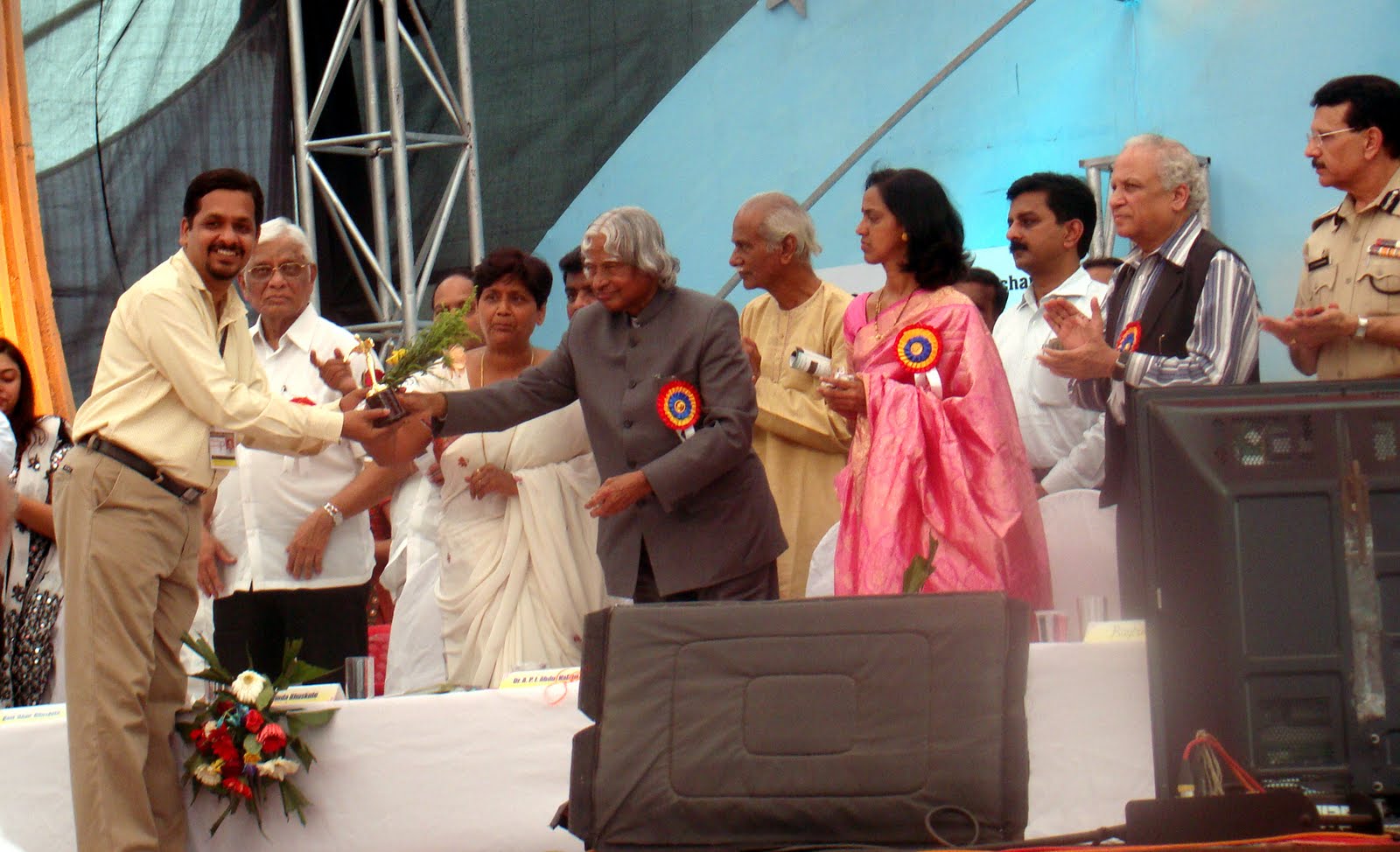
Honored by Dr. A. P. J. Abdul Kalam


It's my great pleasure to inform you that I have been honored with the hands of Former President and BharatRatna Dr. A.P.J. Abdul Kalam on 1st March 2011 for my outstanding contribution in the field of science communication.
The function was organized jointly by Kalyan -Dombivli Municipal Corporation, Arohan and Dombivli Gymkhana at Savlaram Maharaj Krida Sankul, MIDC, Dombivli.
Editor MLA Ravindraji Chavan, MLA Rameshdada Patil, Mayor of KDMC Mrs. Vaijayanti Gujar, Arohan President Mrs. Vinda Bhuskute, Police commissioner K. P. Raghuvanshi, LoksattaKumar Ketkar, IRB President Dattatray Mhaiskar were other dignitaries present for the ceremony.
It was a great moment for me to accept this reward from a such a great personality and in front of about 12000 people. Also, this is my first reward as a science communicator.
I am very much grateful to those who directly or indirectly supported me to achieve this success.

26 August 2009

Does the ban on PLASTIC BAGS work?

Thin plastic bags are the ultimate throwaway item. Used once to tote groceries, the thin white bags often go on to second lives as permanent pollution and an eyesore. So a host of countries, cities and other governments have banned them or forced consumers to pay for them. The largest such country, by far, was China.
Bai si wu ran or "white pollution" seems to have visibly declined but that may have more to do with tidying up garbage than any ban. Even government officials admit the thinnest plastic bags, which were banned outright, are still in use, particularly in remote areas. Small workshops that churn out the contraband bags are easy to set up and hard to police. Small vendors, for their part, seem to think that the rule is no longer enforced and hand them out even in Beijing. Yet, a survey by the International Food Packaging Association found that the number of plastic bags making their way into garbage had declined by 10 percent over the last year and the Chiniese government claimed that supermarkets alone reduced such bag use by 66 percent—some 40 billion fewer plastic bags to get caught in trees, riverbanks or elsewhere. The ultimate hope of the Chinese authorities is for the bags that are used to be recycled. Plastic bags may not disappear anytime soon but they're getting harder to spot.

11 July 2009

What is Eclipse?
— An eclipse is nothing but an obscuring of the light from one celestial body by the passage of another between it and the observer.
— It is primarily caused by the shadow of one celestial body falling on another.

Features of Solar Eclipse on 22 July 2009
— Longest duration of totality in the 21st century – 6 minutes and 39 seconds.
— Path of totality will pass through major cities of India.
— Totality will begin soon after sunrise in Gujarat.
— Monsoon clouds may hamper viewing the eclipse in most places.

Safe Watching Of Eclipse
— The partial phases of the eclipse can be safely observed by projecting the image of the Sun on a white card or a wall.
— A pinhole camera, a small piece of mirror or a low-power telescope can be used for projecting an image of the partially eclipsed Sun.
— Safe filters are available that can be used for viewing the Sun directly.
— It is safe to look at the Sun during totality without a solar filter.


Solar Eclipses Are Not Harmful
— NO harmful rays are emitted by the Sun during an eclipse
— Food or water does NOT get spoiled during an eclipse.
— Eating or going to the toilet during an eclipse does NOT cause any harm.
— A solar eclipse does NOT cause any harm to pregnant mothers or the unborn child.
— A solar eclipse can be observed by anyone with a safe solar filter without any risk.
— Make it a point to watch the total solar eclipse with your family and friends.
Remember, it’s a once-in-a-lifetime experience!

04 May 2009

Black holes in the Milky Way

Black holes are thought to be common in the universe, with a supermassive gobbler lurking at the core of galaxies such as our own Milky Way. But might they also be found roaming outside the galactic centers? A new study estimates that approximately 300 black holes may lurk throughout the Milky Way, remnants of the building blocks that came together billions of years ago to form the galaxy. What is more, those black holes may retain properties that would allow astronomers to identify them, providing an archaeological record of the galaxy's formation.
As galaxies merge, so do their respective central black holes. Previous studies have theorized that the final stage of black hole mergers in low-mass galaxies could release enough energy in the form of gravitational waves, or ripples in the fabric of space and time, to knock the resulting black hole right out of its parent galaxy. This recoil would not be powerful enough, however, to eject the black hole from the Milky Way's gravitational clutches, leaving these free-floating gobblers embedded within the Milky Way.
Scientists simulated the mergers of smaller galaxies in the Milky Way's history, finding that recoiled black holes, ranging in size from roughly 1,000 to a few hundred thousand times the mass of the sun, could exist in relatively large quantities in the Milky Way. (That is small relative to the supermassive black hole presumed to lurk at the Milky Way's core, which has a mass of some four million suns.) None would be particularly close by, the researchers say—at least a few thousand light-years away. A new study estimates that approximately 300 black holes may lurk throughout the Milky Way, remnants of the building blocks that came together billions of years ago to form the galaxy. What is more, those black holes may retain properties that would allow astronomers to identify them, providing an archaeological record of the galaxy's formation.

Web site launched

Please visit my website which is launched recently by veteran scientist and educationist, Padmabhushan awardee Prof. J. B. Joshi. This i...